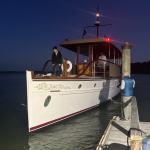
Grace's Logbook #5 - Under The Hood
The Grace History Series
What Drives Her?
This blog is not just for updates on Grace. It will also include periodic historical discussions about the boat, the prior owners, various tales of mystery & imagination and other musings.
This blog post will be part of the History Series where I will give factual accounts and history about the boat and her people. Today the subject is - Grace's Engine.
Grace is not a sailing vessel, she does not sail. Grace is a motor yacht, she cruises. Made of wood and bronze, Grace is a classic example of the early 20th century maritime industry in the United States. Yachting reached new heights in the 1900's with the advent of reliable and powerful power plants...moving away from steam power to the newer gasoline and later diesel motors. These technologies matured rapidly as the industrial revolution moved forward.
Grace was built in 1913 by the New York Yacht Launch and Engine Company (NYYL&E) in Morris Heights New York (In the Bronx, the location is now part of the Roberto Clemente State Park on the banks of the Harlem River). While a small manufacturer, they had a big advantage over many of their competitors...they designed and built the "20th Century" brand gasoline engines at the same yard as they built their custom yachts. Not only did this allow the company to assure availability of their products for each project, it allowed the customer to choose the engine they wished to use in their yacht.
Over the years Grace has had three different engines (four if you take into account the replacement of a more recent one that overheated and cracked while on a cruise.)
The 20th Century Engine


Scan or click QR code to see the engine in action
Her first engine was a "20th Century" gasoline motor that was installed by NYYL&E when the boat was commissioned by Joseph B. Cousins, her original owner. A 4 cylinder, 50 horsepower model was selected primarily given his desire for an easily handled cruiser for local trips, but also powerful enough to take the boat from New York to Miami Florida in the winters. As the 60' full displacement style hull of Grace limits her maximum cruising speed to about 12 knots, a more powerful engine was deemed unnecessary.
The 20th Century motor remained in place until her second owner, James Adams purchased her in 1925. Adams added an enclosed pilot house that year and at the same time upgraded the motor to a 6 cylinder Consolidated "Speedway" gasoline motor rated at 150 horsepower. Consolidated Shipbuilding, like NYYL&E built both custom yachts and their proprietary engines under the same roof. Ironically, the Consolidated Shipbuilding Company was located on property immediately adjacent to NYYL&E in Morris Heights.
The Consolidated Speedway Engine


Scan or click QR code to see the engine in action
The Speedway motor was a workhorse for it's time. It was durable, reliable, and very popular amongst boaters. It powered Grace all the way up to her abandonment in 1978. In fact, when yacht restorer Earl McMillen discovered the rotting yacht (then known as Acquilla) in a Rock Hall Maryland boatyard and rescued her, he dismantled the boat and sold the Speedway motor to a gentleman in Long Island who refurbished it to be installed in a wooden yacht based in Seattle. It is believed that it is still in operation today.
The Caterpillar 3116 Diesel Engine

When McMillen Yachts Inc. restored Acquilla (to become Zapala) in 1995-96, a modern power-plant was installed. As you can imagine, the old gasoline motors had limitations, both in power, and particularly in safety. Many a vintage motor yacht succumbed to fire thanks to their gasoline engines. McMillen chose another, more modern workhorse...the 6 cylinder, 350 horsepower Caterpillar diesel marine engine. A good choice given the limited size of the engine room, and the very long drive shaft from the engine room up front, to the propeller in the rear. Zapala, and later Grace (when she was sold to Palmetto Bluff in SC in 2004) ran extremely reliably with the Cat 3116 until an overheating event led to a cracked engine block in 2021. When The Grace Club acquired the yacht, they sourced a remanufactured replacement Caterpillar 3116 (Introduced in 1986, Caterpillar stopped manufacturing this model in the mid 2000's but because it was so reliable and popular, rebuilt models are fairly readily available) and re-powered Grace once more.
As with many things in Grace's life, technologies change, and Grace has been fortunate to change with them.
Look to future Grace's Logbook entries for more fun and interesting historical stories about Grace.